Blog
Where should a care worker document?


Written by
Sami Sipiläinen
|
Chief Customer Officer
Published on
Where should a care worker document? The answer is simple: wherever it makes the most sense in the care situation at hand. Care workers know best what fits the moment, and good technology leaves room for that judgment.
I talked about this with Virpi Kalakoski, Research Manager at the Finnish Institute of Occupational Health (FIOH), at DigiFinland’s AI-aamu webinar on October 14. We went through FIOH’s “AI solutions in care” project, carried out in three Attendo care homes where care workers document by voice with Moiva.
I’ve been part of this work from the very start, when we began developing AI-assisted voice documentation and bringing it into everyday care work in Attendo’s care homes. Here are a few observations that have stayed with me.
The most efficient way isn’t always the right one
When we set out to develop voice documentation, we didn’t decide in advance where entries should be made. We tried the resident’s room, the corridor, and quiet spaces elsewhere, and learned that the care worker’s own judgment works best.
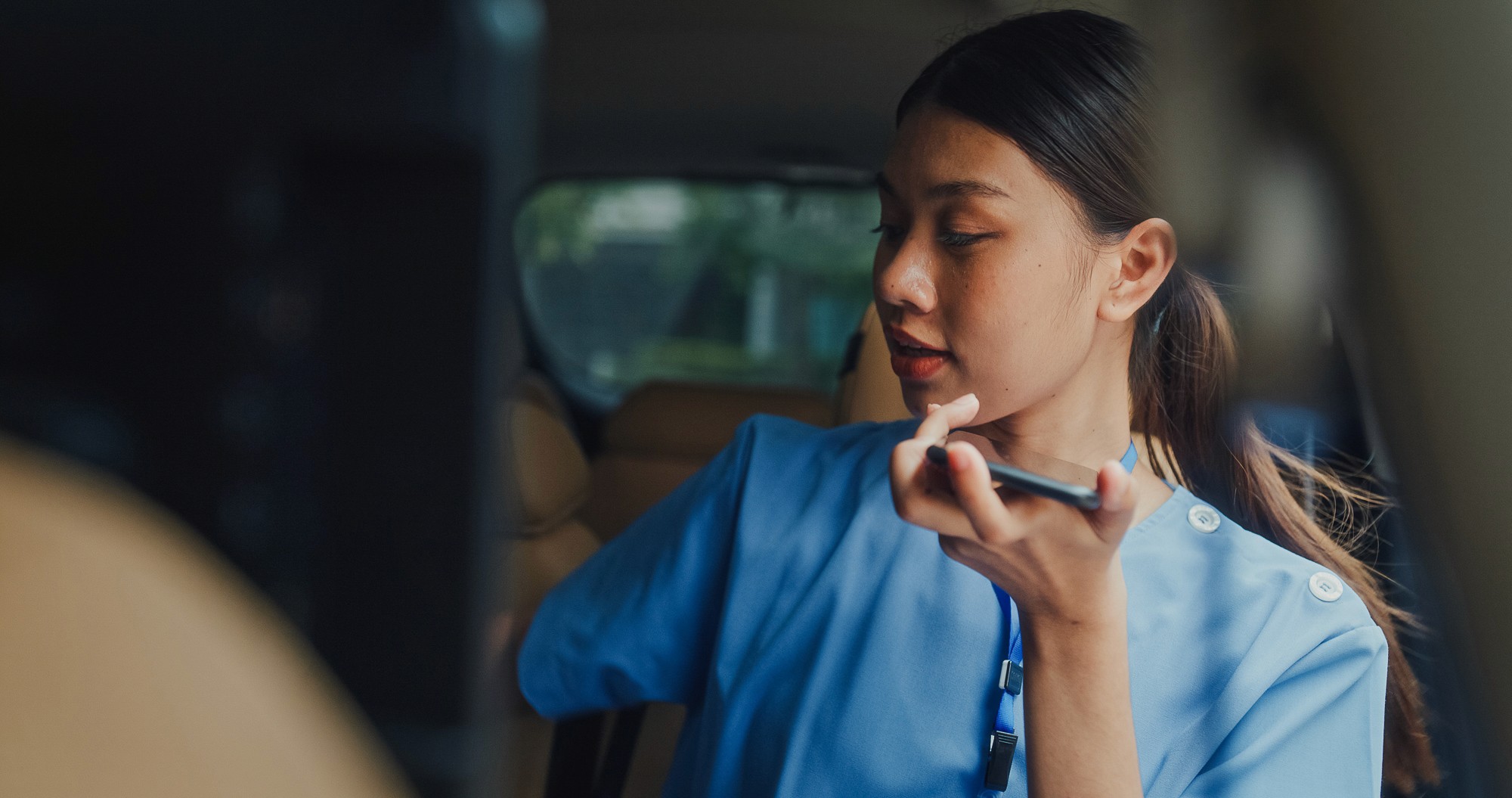
One interesting thing is that the most efficient way of working, technically, isn’t always the best one from the care worker’s point of view. A care worker could, for example, document right away with the resident but chooses the corridor instead, because talking into a phone in front of the resident feels impolite. Once we understand that, we don’t try to force everyone into the same way of working. We develop a solution flexible enough for different situations.
The findings of the FIOH study point the same way. Care workers described documenting next to residents, in residents’ rooms, in the corridor, the kitchen, or the lounge, and stepping aside when privacy called for it. Being able to choose where and when to document strengthened their sense of autonomy.
Families see the change too
A new tool also changes how the work looks to other people. One interesting example of how we’ve put our observations to use has to do with how family members see care workers using phones.
We’ve noticed that while the phone is a work tool for the care worker, one that lets them document right in the care situation, a family member may read the situation quite differently. To them, using a phone can look, for example, as if the care worker’s attention is somewhere other than on the resident.
Once we understand that, we can do something about it. One very simple solution is to tell family members more clearly why care workers use phones and how technology helps them in their work. At the same time, we can work out with care workers in which situations and in what way technology is worth using.
For me, this is a good reminder that introducing technology in care isn’t only a technical question or a matter of training. It touches residents, families, and everyone who sees care workers at work.
Fitting the work and the moment
Put together, these observations say the same thing: technology has to fit the care worker’s work as well as the situation and the people around it.
That also means knowing where voice doesn’t fit. Care comes first, and care workers don’t start dictating when a situation needs their full attention. Voice documentation doesn’t suit every sensitive care situation, and some entries are still more natural to make at a computer. Because all entries end up in the same system, voice and keyboard work side by side.
What the study found
We wrote about the study’s results back in September. In short, documentation spread more evenly across the shift instead of piling up at the end, care workers described a lighter memory load, and the quality of entries stayed at least as good as with a computer. In one of the three care homes, according to a preliminary estimate in the FIOH study, time spent on daily documentation roughly halved, from about 46 to 21 minutes per employee per shift.
Care professionals keep their voice in what we build
Throughout Moiva’s development, I’ve had the chance to spend a lot of time in care homes, following everyday work and listening to care professionals. We’re carrying that on now as we develop Moiva in Finland and internationally. I believe that’s how you end up with tools care workers actually want to use. Technology needs to adapt to care work, not the other way around.
Related articles